
Cloudbet Provably Fair 2026
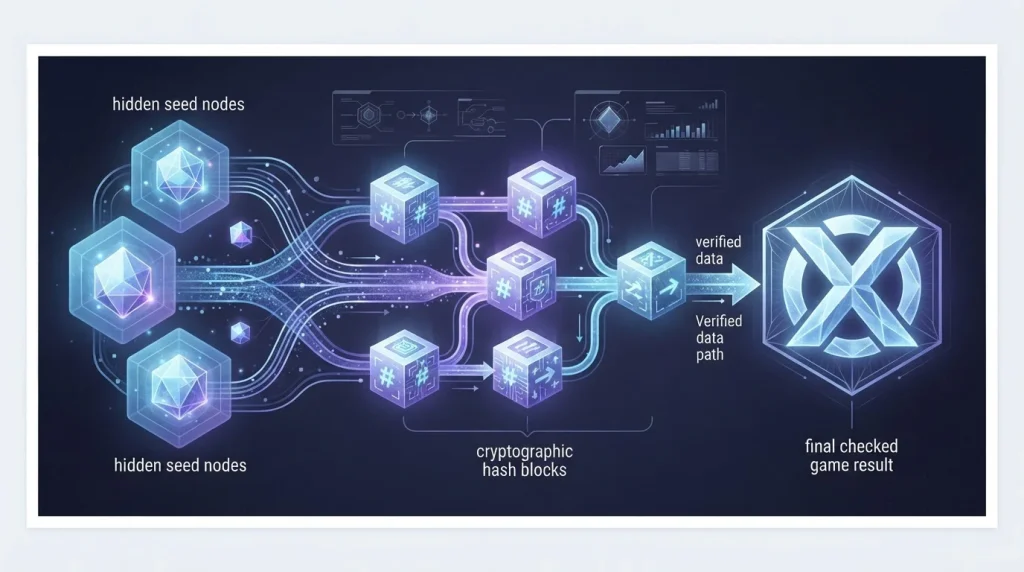
Table of Contents
- Cloudbet Originals use the provably fair system
- Seeds and hashes create a checkable chain
- A four-step check separates commitment from result
- Provably fair answers one specific fairness question
- Verifiability does not reveal whether the odds are attractive
- A repeatable verification habit is more useful than a badge
- Questions about Cloudbet provably fair games
- Verify the round, then judge the game separately
Section element
Outcome verification
Cloudbet has a dedicated Originals section associated with provably fair gaming, including Mines, Limbo, Keno, Dice, Plinko and Crash. The important point is narrow but useful: provably fair can make a digital result auditable without turning that result into a guarantee of favourable odds.
Section element
- Cloudbet sectionCloudbet Originals
- Named originalsMines, Limbo, Keno, Dice, Plinko, Crash
- Verification modelProvably fair
- Originals systemCloudbet Originals use provably fair mechanics
Cloudbet Originals use the provably fair system
Cloudbet separates its branded Originals from the wider third-party game library. Mines, Limbo, Keno, Dice, Plinko and Crash are among the named Originals, and the section is presented as provably fair.
Cloudbet applies its provably fair system to Cloudbet Originals. The support material names Mines, Dice, Advance Dice and Plinko among the games using server seeds, client seeds and a nonce, and the Originals catalogue contains additional in-house formats.
Mines and Keno
Both are named within Cloudbet Originals. Their inclusion shows that the provably fair section covers more than one type of digital game mechanic.
Dice and Limbo
These are also part of the named Originals set, placing simple numerical-result formats inside the same provably fair category.
Plinko and Crash
Cloudbet lists both among its Originals, extending the section to multiplier-style and path-based formats.
The wider Cloudbet games guide shows how Originals sit beside third-party studio games and live dealer tables.
Seeds and hashes create a checkable chain
A typical provably fair system separates information controlled by the game server from information associated with the player or session. Before the result is known, the server can commit to hidden seed material by publishing a cryptographic hash. After the relevant round or seed cycle, the underlying value can be revealed and checked against that earlier commitment.
The hash acts like a fingerprint. Changing the hidden seed changes the resulting hash, so a matching reveal gives the player a way to test whether the committed input was replaced after the outcome became known. The exact formula can vary by game, which is why verification should follow the method attached to the specific title rather than a generic formula copied from another game.
| Verification element | Role in a typical provably fair flow | What the player checks | What it does not answer |
|---|---|---|---|
| Server seed | Hidden input controlled by the game side until reveal | Whether the revealed value matches the earlier commitment | Whether the game has a low house edge |
| Hash commitment | Cryptographic fingerprint published before the hidden value is disclosed | Whether the reveal reproduces the same commitment | Whether a short session will be profitable |
| Client or session input | Adds input outside the hidden server seed in many provably fair designs | Whether the recorded input matches the round being checked | Whether the chosen stake was sensible |
| Result calculation | Transforms the recorded inputs into the game outcome | Whether the published method reproduces the displayed result | Whether the rules favour the player over the house |
A four-step check separates commitment from result
The practical value of provably fair appears only when the chain can be reproduced. The exact controls and labels can differ between titles, but the logic follows the same broad sequence: identify the commitment, obtain the revealed data, reproduce the check and compare the computed result with the recorded round.
- Record the commitment information associated with the round or seed cycle before treating the result as checked.
- After the reveal, compare the disclosed seed material with the earlier hash or commitment value.
- Use the verifier or published calculation for that specific game to reproduce the outcome from the recorded inputs.
- Compare the computed result with the result shown for the round; a mismatch means the verification has not succeeded.
This sequence is intentionally separate from the visual animation of Mines, Dice, Plinko or Crash. Graphics show the game experience; verification checks the underlying input-to-result relationship. A polished animation is not evidence by itself, while a reproducible calculation can be tested after the fact.
Provably fair answers one specific fairness question
The strongest claim supported by provably fair verification is procedural: the completed outcome can be checked against cryptographic inputs and a stated calculation. That narrows the space for a result to be silently altered after the commitment has been made.
This is different from asking whether a game is enjoyable, whether its volatility suits a player’s budget or whether its mathematical return is attractive. Those are separate questions. Outcome integrity is one layer of game evaluation, not the whole evaluation.
What a successful check can establish
- The revealed seed matches the earlier cryptographic commitment.
- The recorded round inputs can be fed into the stated verification method.
- The reproduced result matches the outcome shown for that round.
- The outcome was not simply replaced after the committed input was fixed.
What remains outside that check
- The size of the house edge for a specific game.
- The chance that a short sequence of bets ends ahead.
- Whether a stake size fits the player’s budget.
- Whether the game design encourages longer or faster play than intended.
Verifiability does not reveal whether the odds are attractive
Provably fair and house edge are independent concepts. A game can produce perfectly verifiable outcomes while still giving the house a mathematical advantage. Likewise, a transparent long-run expectation says little about the result of a small number of rounds because variance can dominate short sessions.
No Cloudbet-specific house-edge figure is stated here for the named Originals. That means Mines, Limbo, Keno, Dice, Plinko and Crash should not be assigned one shared edge or RTP. The relevant game rules and any title-specific mathematical information need to be considered separately from the verification mechanism.
- Provably fair
- Checks whether an outcome follows committed cryptographic inputs and a stated calculation.
- House edge
- Describes the mathematical advantage built into a game’s rules over repeated play.
- Variance
- Explains why actual short-run results can differ sharply from long-run expectation.
- Bankroll exposure
- Depends on stake size, number of rounds and the game’s economics, not on verification alone.
The distinction also matters when comparing Originals with the Cloudbet live casino. A live stream offers visual observation of a studio process; provably fair adds a cryptographic method for checking supported digital outcomes. Neither removes gambling risk.
A repeatable verification habit is more useful than a badge
A provably fair label has practical value only when the player can connect it to a specific round. The most useful habit is to test the verification flow before relying on it during a longer session.
- Confirm that the game is inside the Cloudbet Originals or provably fair section before assuming the model applies.
- Locate the seed, hash or verifier information associated with the exact game.
- Record one round’s relevant inputs and reproduce the verification step.
- Keep outcome verification separate from any RTP or house-edge assessment.
- Do not increase a stake because a game is cryptographically auditable.
- Set a fixed gambling budget and stop point before beginning a session.
Crypto funding adds a separate risk layer because asset values can move and blockchain transactions are generally irreversible. The Cloudbet payments guide covers network choice and transaction handling independently from game fairness.
Questions about Cloudbet provably fair games
Does Cloudbet have provably fair games?
Yes. Cloudbet has a dedicated Originals section associated with provably fair gaming.
Which Cloudbet Originals are named in the catalogue?
Named Cloudbet Originals include Mines, Limbo, Keno, Dice, Plinko and Crash.
Which Cloudbet games use provably fair mechanics?
Cloudbet applies the system to Cloudbet Originals. Its support material names Mines, Dice, Advance Dice and Plinko among the games that use server seeds, client seeds and a nonce.
What does provably fair mean?
It means a supported game outcome can be checked against cryptographic inputs and a stated calculation, allowing the player to test whether the recorded result matches the committed data.
Does provably fair mean a Cloudbet game has a low house edge?
No. Provably fair concerns outcome verification. House edge comes from the game’s rules and must be evaluated separately.
Are live dealer games the same as provably fair Originals?
No. Live dealer games use real-time studio presentation, while Cloudbet Originals use provably fair verification for supported digital outcomes.
Verify the round, then judge the game separately
Cloudbet’s provably fair case rests on a dedicated Originals section with named games including Mines, Limbo, Keno, Dice, Plinko and Crash. The useful benefit is auditable outcome generation: a player can check whether a completed result matches committed cryptographic inputs. That check should stay separate from house edge, variance and staking decisions, which determine the economic risk of play rather than the integrity of one checked outcome.